Every ambitious enterprise reaches a critical inflection point where scaling operations requires more than just gut intuition and aggressive advertising; it requires hard, uncompromising data. In the fiercely competitive American digital landscape, pouring capital into marketing without a precise understanding of your financial return is a recipe for rapid budget depletion. Among the myriad of metrics available to modern executives, one stands fundamentally above the rest. Understanding exactly what your Customer Acquisition Cost is, and how it dictates the long-term financial viability of your business, is absolutely non-negotiable for sustainable, predictable growth.
At its core, this metric represents the total total financial investment required to convince a potential lead to open their wallet and purchase your product or service. However, it is far more than a simple accounting figure. It is the ultimate reflection of your marketing efficiency, your brand’s market resonance, and the technical friction present within your digital ecosystem. When a business masters this data point, they transition from merely surviving month-to-month to engineering a highly scalable, revenue-generating machine that dominates their respective industry.
The Financial Pulse of Your Business Operations
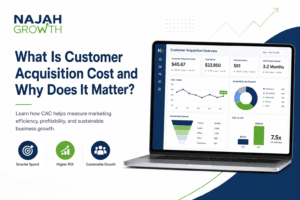
To truly comprehend the gravity of this metric, we must first deconstruct how it is calculated and why financial analysts obsess over it. The mathematical formula is deceivingly simple: you take your total sales and marketing expenses over a specific period and divide that number by the total number of new customers acquired during that exact same timeframe.
These expenses are comprehensive. They do not just include your daily ad spend on Google or Meta. A precise calculation must account for the salaries of your marketing and sales teams, the cost of your digital marketing software stack, the fees paid to creative agencies, and the operational overhead associated with running your campaigns. For example, if your company spends $50,000 in a quarter on all combined sales and marketing efforts and successfully closes 500 new clients, your Customer Acquisition Cost is exactly $100 per user.
But is $100 a favorable number? That question brings us to the core reason why this metric matters so profoundly. A standalone cost means nothing without context. If you are selling enterprise software where an average contract is worth $50,000 annually, spending $100 to acquire a client is an astronomical success. Conversely, if you are an e-commerce retailer selling $15 coffee mugs, a $100 acquisition expense will bankrupt your operation within weeks. This is why tracking your acquisition expenditures is the only way to ensure your business model is actually sustainable in the real world.
The Devastating Impact of Inefficiency
Many businesses struggle with stagnant growth simply because they do not realize how rapidly an unoptimized marketing strategy bleeds capital. When your Customer Acquisition Cost steadily rises, it is a glaring distress signal indicating that your current market approach is losing its effectiveness. This inflation often occurs due to rising advertising bids, increased market competition, or—most commonly—a severe disconnect between your advertising messaging and your website’s user experience.
When a potential buyer clicks on a paid advertisement, you have already spent the money. If that user lands on a digital storefront that takes six seconds to load, features confusing navigation, or lacks a clear value proposition, they will immediately abandon the page. This phenomenon, known as a high bounce rate, is the primary culprit behind inflated acquisition expenses. You are essentially paying premium rates to drive high-intent traffic into a digital brick wall. To stop this financial hemorrhage, organizations must look beyond their ad accounts and heavily scrutinize the technical infrastructure of their digital presence. View industry benchmarks for digital marketing efficiency and bounce rates.
Architecting a Frictionless User Journey
To aggressively lower your Customer Acquisition Cost, you must bridge the gap between initial awareness and final conversion. This is where the intersection of advanced web development and consumer psychology becomes your most valuable asset. A technically flawless website acts as your highest-performing sales representative—one that works twenty-four hours a day, never takes a vacation, and meticulously guides users toward a purchasing decision.
Conversion Rate Optimization (CRO)
The most direct method to reduce your acquisition expenses is to improve your website’s conversion rate. If you are currently spending $10,000 to drive 10,000 visitors to your site, and your conversion rate is 1%, you generate 100 customers. This means your Customer Acquisition Cost is $100. However, if you restructure your landing pages, streamline the checkout process, and deploy persuasive, benefit-driven copywriting, you might increase that conversion rate to 2%. Without spending a single extra dollar on advertising, you are now generating 200 customers from the exact same traffic pool, effectively slicing your acquisition cost in half to just $50.
This requires a meticulously crafted user interface (UI) and user experience (UX) design. Modern consumers have zero tolerance for clunky forms, broken mobile layouts, or ambiguous calls to action. Every single element on your website must be engineered with intentionality to remove friction and propel the user toward the final transaction.
Leveraging High-Intent Organic Traffic
Relying entirely on paid advertising is a dangerous long-term strategy, as platforms continuously increase their cost-per-click thresholds. The most successful modern brands offset these expenses by building formidable organic search visibility. By investing heavily in technical search engine optimization and publishing deeply informative, high-value content, you can attract thousands of highly qualified leads without paying for each individual click.
Over time, as your organic traffic compounds, the overall volume of customers acquired increases while your marketing expenses remain relatively stable. This creates a beautifully inverse relationship: as your organic digital footprint expands, your blended Customer Acquisition Cost plummets, resulting in unparalleled profit margins. Schedule a comprehensive technical web audit to uncover your hidden traffic opportunities.
Measuring Lifetime Value (LTV) Against Acquisition Expenses
Understanding what you pay to acquire a buyer is only half of the strategic equation. To truly unlock scalable growth, you must constantly measure this metric against Customer Lifetime Value (LTV). LTV represents the total gross profit a business can reasonably expect to generate from a single customer throughout the entire duration of their relationship.
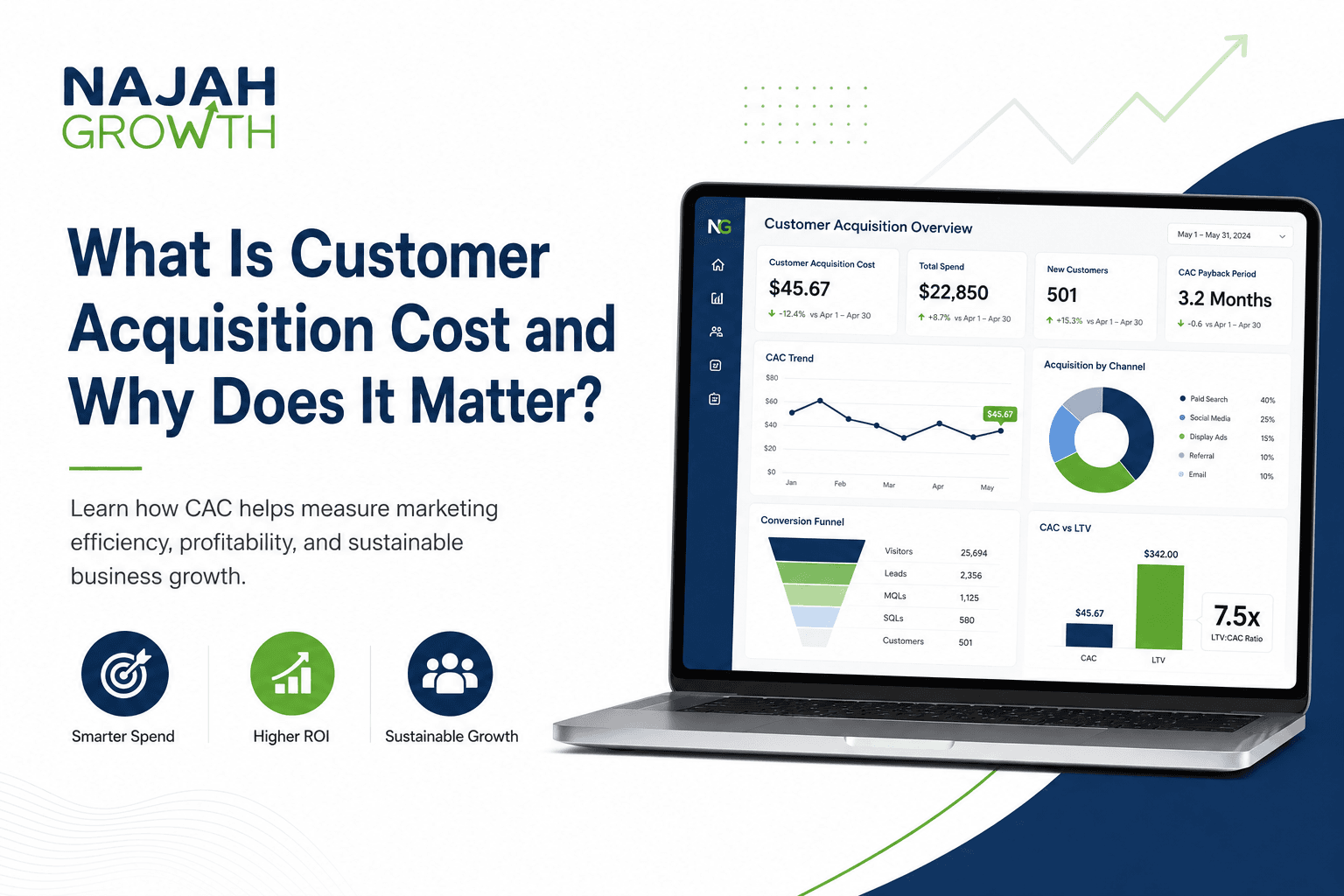
The relationship between these two numbers is widely considered the golden ratio of business scaling. Industry leaders consistently aim for an LTV to acquisition cost ratio of 3:1 or higher. This means that if it costs you $100 to acquire a new buyer, that buyer should ideally generate at least $300 in gross profit over their lifetime.
If your ratio is 1:1, you are merely breaking even, and your business is likely stagnating. If your ratio is lower than 1:1, you are actively losing money with every new sale. However, if your ratio is exceptionally high—such as 6:1 or 7:1—it is a clear signal that you have achieved phenomenal market fit, but you are likely underinvesting in marketing. In this scenario, you should aggressively increase your marketing budget to capture a larger share of the market, secure in the knowledge that your operations are highly profitable.
Generative Engine Optimization: The Future of Acquisition
We are currently witnessing a massive paradigm shift in how consumers discover products and services. The integration of large language models and artificial intelligence into search engines has fundamentally altered the digital discovery process. Users are no longer just typing fragmented keywords; they are asking complex, conversational questions and expecting immediate, highly synthesized answers.
To keep your Customer Acquisition Cost remarkably low in this new era, your brand must adapt to Generative Engine Optimization (GEO). This involves structuring your website’s data and content so flawlessly that AI-driven search engines prefer your platform as the definitive source of truth. When your brand is consistently cited by generative AI engines, you capture a massive segment of zero-click and high-intent traffic, completely bypassing the traditional, expensive paid advertising bidding wars.
Adapting to this requires a professional team that understands the underlying mechanics of natural language processing and semantic HTML architecture. It requires transitioning from an outdated online brochure to a dynamic, scalable digital ecosystem.
Frequently Asked Questions (FAQ)
What is the simplest way to calculate Customer Acquisition Cost?
The simplest formula is to take your total sales and marketing expenses (including salaries, software, ad spend, and agency fees) over a specific time period and divide that sum by the total number of new customers acquired during that same period.
Why is my Customer Acquisition Cost suddenly increasing?
An increasing acquisition expense typically points to a few common culprits: ad fatigue (your audience is tired of seeing the same advertisements), increased bidding competition on your primary marketing channels, or a technical degradation on your website that is causing a higher bounce rate and lowering your conversion efficiency.
What is the difference between CPA and CAC?
While often used interchangeably, they are distinct metrics. Cost Per Action (CPA) usually measures the cost to acquire a specific action, such as a lead submission, an email signup, or a free trial registration. Customer Acquisition Cost specifically measures the financial investment required to secure a fully paying customer.
Can professional web design actually lower my marketing costs?
Absolutely. A professionally engineered website optimized for mobile responsiveness, lightning-fast load speeds, and intuitive user experience will naturally convert a much higher percentage of your incoming traffic. When your conversion rate increases, the amount you spend to acquire each individual buyer automatically decreases.
How does Customer Lifetime Value (LTV) affect my marketing budget?
LTV dictates how much you can afford to spend on acquisition. If your average customer generates $5,000 in profit over five years, you can aggressively spend $1,000 to acquire them and still maintain a highly profitable 5:1 ratio, giving you a massive competitive advantage over rivals with lower LTVs.
Transform Your Digital Ecosystem and Scale Your Revenue
Understanding your data is only the first step; executing a strategy to optimize it is where true market dominance is achieved. Slashing your Customer Acquisition Cost requires a dedicated, elite partner that intimately understands the complex mechanics of generative search algorithms, advanced consumer psychology, and enterprise-grade web architecture. You cannot afford to let inefficient marketing campaigns and unoptimized landing pages drain your operational capital any longer.
At Najah Growth, we do not just build websites; we engineer scalable, revenue-generating digital ecosystems designed to force the market to pay attention. We are ready to dissect your unique business challenges, identify the bottlenecks in your sales funnel, and architect a customized blueprint that maximizes your conversion rates and dramatically lowers your acquisition expenses. Stop leaving your digital destiny to chance. Boost your sales and schedule your strategic digital consultation with NajahGrowth.com today. Let us partner together to transform your ambitious vision into an undisputed, highly profitable digital reality.