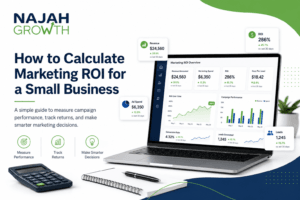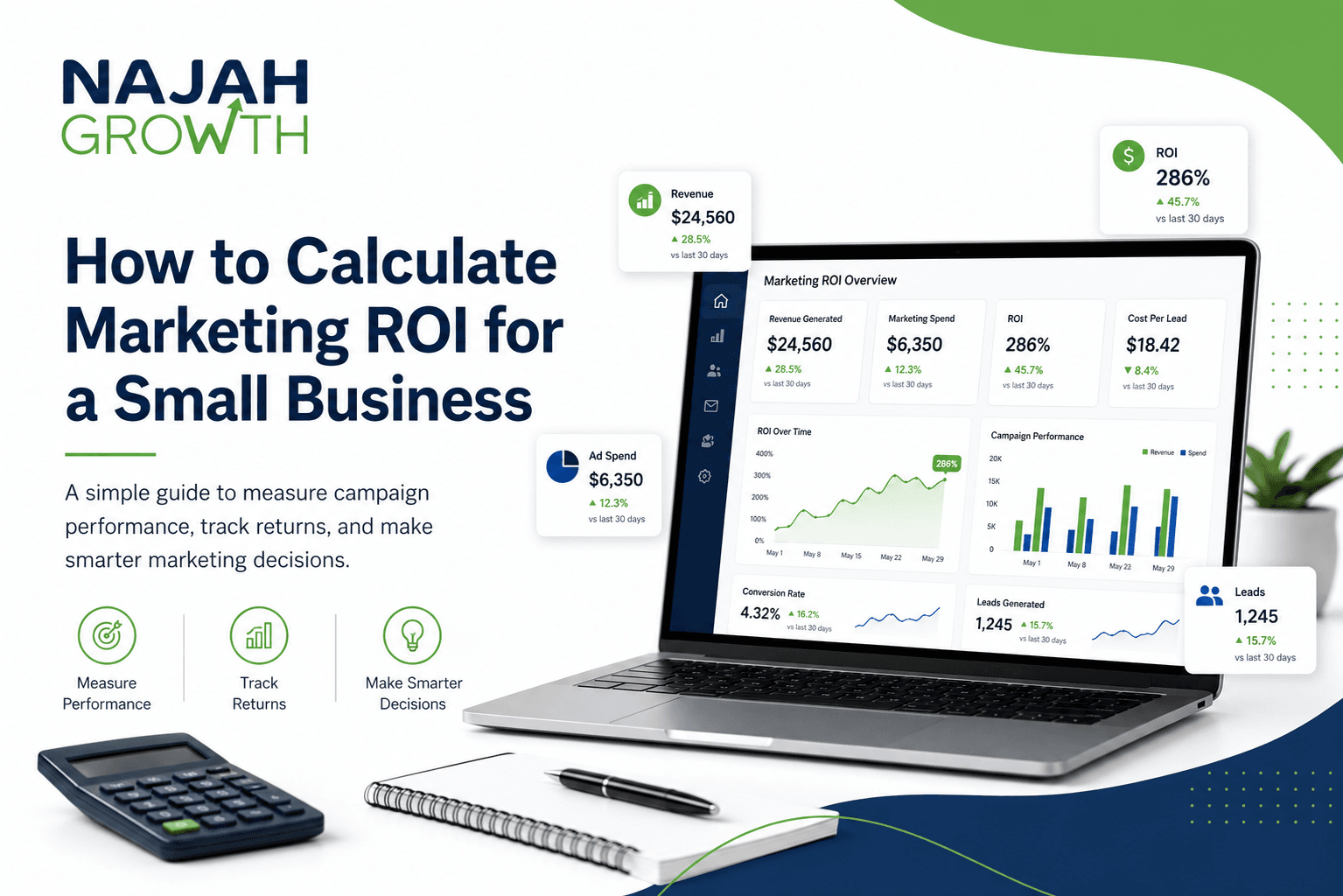
In today’s hyper-competitive American business landscape, every single dollar spent on customer acquisition must be rigorously accounted for and strategically justified. Gone are the days when local enterprises could blindly throw capital at print ads, billboards, or generic digital campaigns without measuring the direct, bottom-line financial impact. If you want to outmaneuver entrenched competitors and scale your operations efficiently, you must learn how to Calculate Marketing ROI for a Small Business with absolute precision. This is not merely an accounting exercise; it is the fundamental digital blueprint for survivability and aggressive commercial expansion. When you intimately understand exactly which campaigns are driving high-intent revenue and which are bleeding cash, you transform your marketing from an unpredictable overhead expense into a scalable, highly reliable revenue-generating engine.
The Crucial Foundation: Why Return on Investment Dictates Market Dominance
For small businesses operating on tight margins, capital allocation is everything. Enterprise-level corporations might have the luxury of spending millions on broad “brand awareness” campaigns that are difficult to track, but a smaller enterprise must demand a direct and measurable return on every investment. The modern consumer journey is highly fragmented, jumping between search engines, social media, and localized directories before making a purchasing decision.
Without a sophisticated tracking mechanism in place, business owners are essentially flying blind. You might notice an uptick in overall sales, but without hard data, you cannot confidently identify the catalyst. Was it your new highly optimized website structure? The aggressive Google Ads campaign you launched last week? Or the organic search engine optimization (SEO) strategy you implemented months ago? Identifying the exact source of your revenue allows you to double down on winning strategies and ruthlessly cut underperforming assets.
Shifting from Vanity Metrics to Tangible Commercial Success
A common and highly destructive pitfall in the digital marketing world is an obsession with vanity metrics. Too many business owners and inexperienced agencies chase raw website traffic, social media followers, or post “likes” without ever analyzing the transactional intent behind those engagements. Ten thousand visitors searching for free information will yield significantly less revenue than fifty highly qualified leads actively looking to purchase your specific service.
True digital success is measured exclusively by the bottom line. When you attempt to Calculate Marketing ROI for a Small Business, you must strip away the superficial fluff and focus entirely on the gross profit generated by your specific marketing initiatives. Generating traffic is easy; generating high-converting, revenue-producing traffic requires advanced web architecture, consumer psychology, and relentless data analysis.
The Core Formula: The Mathematics of Digital Growth
At its absolute core, determining your marketing return on investment relies on a straightforward mathematical formula. The standard calculation used by elite financial strategists and digital marketers is:
(Sales Growth – Marketing Investment) / Marketing Investment = Marketing ROI
To express this as a percentage, you simply multiply the final number by 100. While this formula appears incredibly simple on the surface, accurately defining those two primary variables—Sales Growth and Marketing Investment—is where the vast majority of small businesses make critical calculation errors.
Defining Your Variables Accurately for Absolute Precision
When determining your Marketing Investment, you cannot simply look at your raw advertising spend. A true ROI calculation must be holistic. If you are running a comprehensive digital campaign, your costs include the actual media spend (the money paid directly to Google or Meta), the software subscriptions required to run the campaigns, the cost of content creation (copywriting, video production, graphic design), and the fees paid to your internal marketing team or your external digital agency partner.
Similarly, when defining Sales Growth, it is vital to isolate the sales that were directly influenced by the marketing campaign. If your baseline organic revenue is naturally $10,000 a month, and a new campaign pushes your total revenue to $15,000, the Sales Growth attributed to that specific campaign is $5,000, not the total $15,000. For further insights into complex data analysis and tracking consumer search behavior, you can reference the latest search engine market share and analytics reports by Statcounter.
Integrating Customer Lifetime Value (CLV) into Your Strategy
One of the most advanced shifts in strategic thinking occurs when a business stops looking at single-transaction metrics and begins focusing on the long-term horizon. If you only Calculate Marketing ROI for a Small Business based on the very first purchase a customer makes, you are drastically undervaluing your marketing efforts and artificially restricting your growth potential.
Customer Lifetime Value (CLV) represents the total amount of revenue a business can reasonably expect from a single customer account throughout the entirety of their relationship. For example, if you run a local tax consulting firm, it might cost you $300 in advertising to acquire a new client. If their first consultation only yields $250, your immediate ROI appears negative. However, if that client retains your services for five years, bringing in $1,000 annually, the true value of that acquisition is $5,000.
The Impact of Recurring Revenue on Market Aggression
Understanding CLV completely alters how aggressively you can maneuver in your local or national market. Businesses that intimately know their CLV can afford to spend significantly more to acquire a customer than competitors who are solely focused on immediate, short-term profitability. By factoring CLV into your calculations, you can scale your paid acquisition channels, outbid your competitors for premium search terms, and systematically dominate your industry’s digital landscape.
Tracking and Attribution in a Complex Digital Ecosystem
In a modern, omnichannel digital strategy, a customer rarely clicks an ad and purchases immediately. They might discover your brand through an organic search, click a retargeting ad on social media three days later, and finally convert after receiving an email newsletter. This complex journey makes tracking incredibly difficult. To accurately Calculate Marketing ROI for a Small Business, you must implement a robust attribution model that accurately credits the channels responsible for driving the final conversion.
Leveraging Advanced Analytics for Granular Precision
The days of asking customers “How did you hear about us?” are over. Your digital infrastructure must be engineered to capture this data automatically. This involves implementing flawless conversion tracking mechanisms on your website, utilizing specific UTM parameters for all outbound links, and employing dynamic call-tracking software to attribute inbound phone calls to the exact keywords that generated them.
Furthermore, your marketing data must seamlessly integrate with your Customer Relationship Management (CRM) software. This closed-loop reporting allows you to track a lead from their very first digital interaction all the way through to the final closed sale, providing an irrefutable, data-backed view of exactly which campaigns are yielding the highest commercial returns.
Turning Data Into Market Dominance: Scaling What Works
The ultimate goal of tracking your analytics is not simply to have a neat spreadsheet; it is to weaponize that data to drive continuous business expansion. Once you possess the ability to accurately Calculate Marketing ROI for a Small Business, you unlock the power of strategic resource reallocation.
If your data reveals that your specialized SEO content silos are generating a 600% ROI, while your broad social media awareness campaigns are only breaking even, the strategic move is clear. You aggressively reallocate your capital away from the underperforming assets and pour it directly into the channels that are forcing the market to pay attention. This relentless optimization cycle is the exact blueprint used by industry leaders to capture market share and drive unparalleled commercial success.
Frequently Asked Questions (FAQ)
Why is it so historically difficult to Calculate Marketing ROI for a Small Business? The difficulty stems from the complexity of the modern consumer journey and the challenge of accurate attribution. Consumers interact with multiple digital touchpoints (search, social media, email) before converting. Additionally, businesses that generate offline sales (like phone calls or in-store visits) often struggle to link those physical transactions back to the original digital campaign without advanced, integrated tracking software.
What is generally considered a “good” marketing return on investment? While this varies wildly depending on your industry’s profit margins, a widely accepted benchmark for a strong marketing ROI is 5:1 (a 500% return). This means for every dollar spent on marketing, five dollars in gross profit is generated. An ROI of 10:1 is considered exceptional, while an ROI below 2:1 often means the campaign is barely covering the overhead costs associated with delivering the product or service.
Should I include my internal team’s time when calculating marketing expenses? Absolutely. A common mistake is only calculating external ad spend (like payments to Google). To achieve absolute precision in your calculations, you must include the cost of the labor required to manage the campaigns, the software subscriptions used to execute them, and the creative costs involved in producing the digital assets.
How does organic Search Engine Optimization (SEO) fit into ROI calculations? Organic SEO requires a different timeframe for ROI calculation compared to immediate Pay-Per-Click (PPC) ads. While SEO requires significant upfront investment in technical architecture and content development, it typically yields the highest long-term ROI of any digital channel. In competitive American markets, businesses should measure SEO ROI over a 6-to-12-month horizon to accurately capture the compounding value of sustained organic traffic.
Can you accurately measure the ROI of social media marketing? Yes, but it requires strict discipline. You must utilize advanced tracking links (UTM parameters) and pixel tracking to trace users from the social media platform directly to the conversion event on your website. Without these technical foundations in place, social media marketing quickly devolves into an unmeasurable vanity exercise.
Architect Your Future-Proof Digital Empire
Mastering the mathematics of your marketing is not a DIY task; it requires an elite team that intimately understands the mechanics of generative algorithms, advanced web architecture, and revenue-driven performance marketing. Settling for an outdated online brochure or generic advertising campaigns is a guaranteed path to digital obscurity. It is time to transition from merely surviving in the digital space to completely dominating your industry through data-backed, aggressive market acquisition.
At Najah Growth, we are engineered to dissect your unique business challenges, uncover hidden market opportunities, and architect a highly customized blueprint that forces the market to pay attention. We do not just build websites or run ads; we build scalable digital ecosystems that fuel continuous business expansion, drive high-intent traffic, and aggressively maximize your revenue. Do not let your brand’s true potential remain untapped while your competitors surge ahead. Boost your sales and schedule your strategic digital consultation with NajahGrowth.com today. Let us partner together to build a future-proof digital empire that commands unwavering attention and drives unparalleled commercial success.