
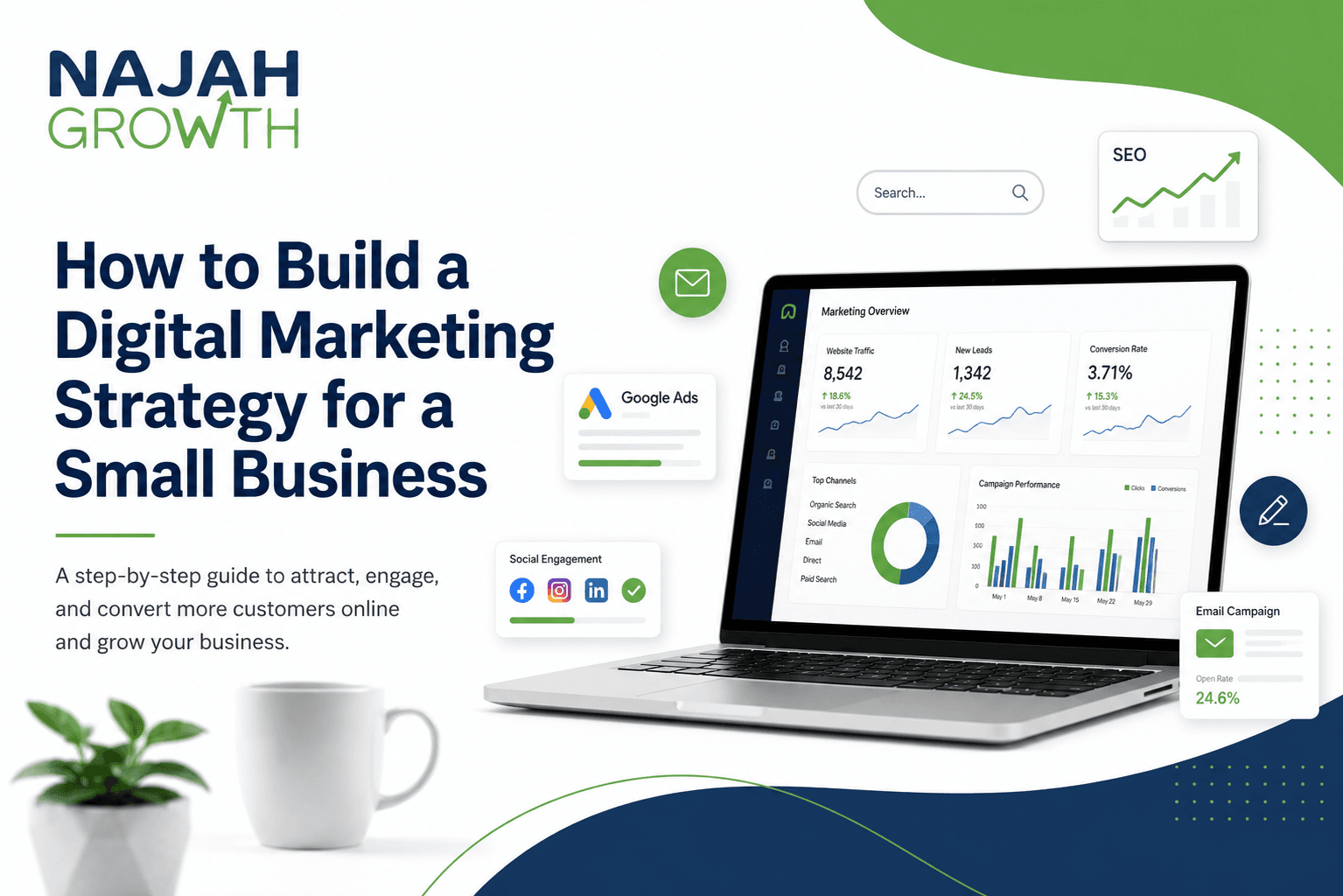
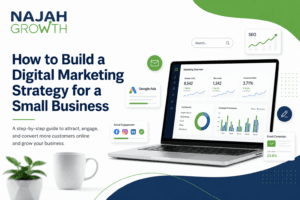
In today’s hyper-competitive American market, relying on an outdated online brochure is a guaranteed path to digital obscurity. To survive and dominate your industry, you must master how to build a Digital Marketing Strategy for a Small Business that actively serves as a scalable, revenue-generating ecosystem. The days of simply launching a website and hoping for local foot traffic or organic inquiries are completely over. As consumer psychology shifts and generative algorithms redefine how people search for products and services, your approach must evolve from passive brand visibility to aggressive, data-driven market acquisition. Crafting a winning blueprint requires an intimate understanding of complex search algorithms, user experience design, and high-conversion copywriting. By architecting a technically flawless platform and executing precise omnichannel campaigns, you force the market to pay attention, outmaneuver entrenched competitors, and turn ambitious commercial visions into an undisputed digital reality.
The Anatomy of a High-Converting Digital Ecosystem
When developing a Digital Marketing Strategy for a Small Business, the absolute first step is recognizing that your website is the foundational core of your entire operation. Driving thousands of users to a slow, confusing, or poorly designed website is a massive waste of capital. Top-tier American agencies understand that before launching paid advertisements or aggressive content campaigns, the digital infrastructure must be perfected.
Your website must load instantly, adapt flawlessly to any mobile device, and guide the user through a frictionless journey toward a conversion. This requires stripping away bloated code, utilizing semantic HTML, and engineering a user interface (UI) that aligns with modern behavioral expectations. Every micro-interaction, from the navigation menu to the contact form, must be optimized to eliminate hesitation. A seamless user experience not only keeps potential clients on your page longer but also sends powerful positive signals to search engines regarding the quality and relevance of your platform.
Technical Foundations and Site Architecture
Underneath the visual design lies the critical realm of technical performance. Search engine crawlers operate on strict efficiency budgets; if your site architecture is convoluted, vital pages will remain undiscovered. Implementing a logical, hierarchical site structure ensures that crawlers can easily map your domain and understand the relationship between different topics. This involves utilizing properly formatted XML sitemaps, optimizing server response times, and ensuring secure HTTPS protocols are rigorously enforced.
Furthermore, structured data markup must be implemented to translate your web content into the native language of search engines. By meticulously defining your business details, products, and reviews through schema, you dramatically increase the likelihood of capturing highly visible rich snippets in the search results.
Shifting from Vanity Metrics to Targeted Revenue
A common pitfall in any Digital Marketing Strategy for a Small Business is an obsession with vanity metrics—chasing raw traffic numbers without analyzing the intent behind those clicks. One thousand visitors searching for free information will yield less revenue than fifty visitors actively looking to purchase your specific service. True market dominance requires a pivot toward high-intent, transactional traffic.
This is achieved through rigorous, data-backed keyword research. Instead of guessing what your audience is searching for, you must analyze actual search volumes, assess competitor gaps, and map specific phrases to the corresponding stages of the buyer’s journey. The goal is to intercept the consumer exactly at the moment they are ready to make a purchasing decision.
Mastering Search Intent and Content Silos
Once high-value search terms are identified, your content architecture must be built to satisfy the precise intent of the user. If a user is searching for a local service provider, they expect clear pricing, service areas, and contact methods, not a theoretical essay on the industry. By grouping related topics into comprehensive content silos—often utilizing a pillar page supported by deeply detailed cluster articles—you establish your platform as the definitive resource in your niche.
This systematic approach builds topical relevance, demonstrating to search engine algorithms that your domain possesses a comprehensive understanding of the subject matter. Every piece of content must be strictly optimized with logical heading tags, compelling meta descriptions, and clean URL structures to maximize its indexing potential. For a deeper understanding of how global algorithmic updates impact these strategies, you can review the latest search engine market share reports by Statcounter.
Content that Commands Attention and Drives Action
Words are the ultimate currency of the internet. However, generic, uninspired copywriting will fail to convert even the most qualified leads. Your content must seamlessly blend technical optimization with aggressive, persuasive sales psychology. Utilizing proven frameworks like Attention, Interest, Desire, and Action (AIDA) ensures that your copy guides the reader logically toward a conversion.
The messaging must immediately address the core pain points of your target demographic, agitate those specific challenges, and position your service as the ultimate, undeniable solution. It is not enough to simply state what you do; you must clearly articulate the unique value proposition that separates you from every other competitor in the market. Integrating advanced analytics into your Digital Marketing Strategy for a Small Business ensures that you can continually A/B test headlines, calls-to-action, and value propositions, refining your approach based on hard data rather than intuition.
Advanced Tactics: AI and Generative Engine Optimization
We are currently witnessing a massive paradigm shift in how information is retrieved online. Traditional search is rapidly being augmented by artificial intelligence and Large Language Models (LLMs). A forward-thinking blueprint must account for Generative Engine Optimization (GEO) and Answer Engine Optimization (AEO).
To ensure your brand is cited by AI overviews and conversational search tools, your content must provide direct, factual, and highly structured answers to complex queries. This involves anticipating conversational long-tail questions and formatting your content in easily digestible, easily extractable formats. Staying ahead of this technological curve is what separates industry leaders from those left scrambling to catch up.
The Crucial Role of Local Market Dominance
For the vast majority of local enterprises, capturing the immediate geographic radius is the lifeblood of the business. Optimizing your localized presence requires a distinct set of tactics separate from broad national campaigns. A highly optimized Google Business Profile is mandatory. This profile must be meticulously maintained with accurate categorization, updated imagery, and a continuous stream of authentic customer reviews.
Furthermore, establishing consistent Name, Address, and Phone Number (NAP) data across premier business directories and industry-specific aggregators solidifies your geographic relevance. Localized link-building—securing mentions from local news outlets, sponsorships, and community organizations—further cements your digital footprint in the specific region you serve.
Frequently Asked Questions (FAQ)
What is the most critical element of a Digital Marketing Strategy for a Small Business? The most critical element is establishing a technically flawless, high-converting website foundation. Before investing in traffic generation through SEO or paid ads, your digital platform must offer a seamless user experience, fast load times, and a clear path to conversion to ensure you are not wasting marketing capital.
How long does it take to see a return on investment (ROI) from an organic search campaign? In highly competitive American markets, a comprehensive organic search campaign typically requires 4 to 6 months to begin showing significant, measurable traction. This timeline depends heavily on the current state of your website’s architecture, the aggressiveness of your content output, and the strength of your competitors.
Do I need to run Pay-Per-Click (PPC) ads if I am already investing in organic search? Yes, utilizing a multi-channel approach is highly recommended. While organic search builds long-term, sustainable equity and traffic, PPC advertising provides immediate visibility and cash flow. Data gathered from your paid campaigns can also be used to rapidly refine and accelerate your long-term organic strategies.
How is Artificial Intelligence changing the way small businesses should approach search optimization? AI is shifting search from simple keyword matching to conversational, intent-based answers. Businesses must now optimize for Answer Engine Optimization (AEO) by structuring content to directly answer complex user questions, ensuring their brand is cited as the definitive source in AI-generated overviews.
Why is local directory consistency so vital for geographic visibility? Search engines rely on data consistency across the web to verify the legitimacy and exact location of your business. If your business name, address, or phone number varies across different directories, it creates algorithmic confusion, which can severely penalize your ability to rank in the crucial local map pack results.
Stop Surviving and Start Dominating Your Market
Executing a flawless Digital Marketing Strategy for a Small Business is not a DIY task; it requires a dedicated, elite team that intimately understands the mechanics of generative algorithms, consumer psychology, and advanced web architecture. The digital landscape is too complex and the competition too fierce to rely on guesswork or generic templates. It is time to transition from merely surviving in the digital space to completely dominating your industry.
At Najah Growth, we are engineered to dissect your unique business challenges, uncover hidden market opportunities, and architect a customized blueprint that forces the market to pay attention. We do not just build websites or run ads; we build scalable digital ecosystems that fuel continuous business expansion, drive high-intent traffic, and aggressively maximize your revenue. Do not let your brand’s true potential remain untapped while your competitors surge ahead. Boost your sales and schedule your strategic digital consultation with NajahGrowth.com today. Let us partner together to build a future-proof digital empire that commands unwavering attention and drives unparalleled commercial success.


One Response
I like the emphasis on treating a website as the foundation of a broader digital ecosystem rather than just an online brochure. One challenge many small businesses face is trying to be everywhere at once, so prioritizing a few channels, tracking meaningful metrics, and improving the user experience over time can often deliver better results than spreading resources too thin.