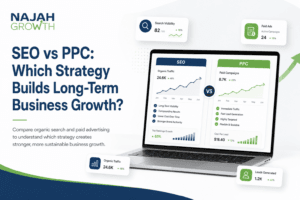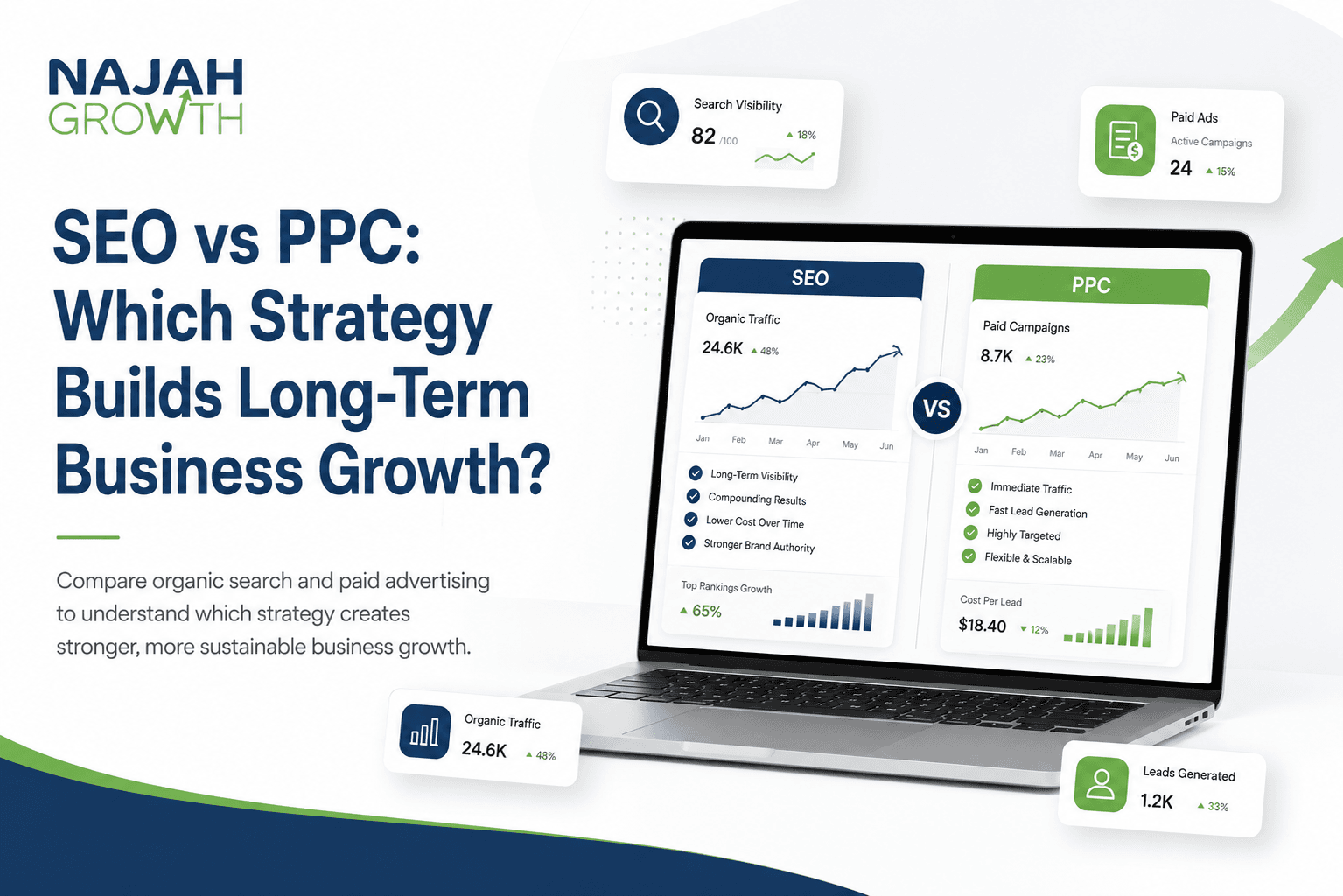
In the fiercely competitive American digital marketplace, business owners are constantly faced with a critical capital allocation dilemma: should you invest your marketing budget in Search Engine Optimization (SEO) or Pay-Per-Click (PPC) advertising? The answer to this question dictates not only your immediate cash flow but the ultimate survivability and valuation of your enterprise. To truly understand SEO vs PPC: Which Strategy Builds Long-Term Business Growth?, you must strip away the industry buzzwords and analyze these strategies mathematically. Both avenues aim to drive high-intent, transactional traffic to your digital ecosystem, but they operate on fundamentally different economic models. Relying exclusively on one while ignoring the other is a strategic vulnerability that aggressive competitors will exploit.
Immediate Visibility vs. Compounding Equity
The core difference between paid advertising and organic search visibility lies in the concept of digital equity. When you deploy a digital marketing strategy, you are either renting space in the search results or you are building your own permanent real estate. Understanding this dynamic is crucial for architecting a blueprint that scales efficiently over time without continually bleeding profit margins.
The Power and Peril of Pay-Per-Click (PPC)
Pay-Per-Click advertising—most notably through platforms like Google Ads—is the ultimate tool for immediate market aggression. The moment a meticulously crafted PPC campaign is launched, your brand is forced to the absolute top of the search engine results pages (SERPs) for your target keywords.
Immediate Cash Flow: PPC intercepts consumers precisely when they have high commercial intent, driving immediate leads and revenue.
Granular Control: You dictate the exact search terms, geographic radius, and demographic targeting.
The Rental Trap: The critical flaw of PPC is that it builds zero digital equity. The exact second your advertising budget is depleted, your visibility vanishes completely. You are perpetually beholden to rising Cost-Per-Click (CPC) rates dictated by your competitors.
Search Engine Optimization (SEO) as a Foundational Asset
Conversely, organic Search Engine Optimization is the process of engineering your website’s architecture, content, and authority to earn a permanent position in the search algorithms. It requires a heavy initial investment of time, technical expertise, and content development, but the long-term economic upside is unparalleled.
Compounding Returns: Unlike PPC, the cost of organic traffic decreases over time. An optimized pillar page can generate thousands of highly qualified leads for years without requiring an ongoing, per-click payment.
Market Authority: Consumers fundamentally trust organic results more than sponsored ads. Dominating the organic real estate signals to the market that you are the undisputed industry leader.
The Moat Effect: A properly executed SEO strategy creates a deep competitive moat. While a new competitor can outbid you on Google Ads tomorrow, they cannot easily replicate five years of established domain authority and semantic content relevance.
Strategic Comparison: Analyzing the Digital Battlefield
To make an informed, data-driven decision regarding your capital allocation, you must evaluate how these two strategies compare across key operational metrics.
| Strategic Metric | SEO (Organic Search) | PPC (Paid Advertising) |
| Speed to Market | 4 to 8 months to gain measurable traction | Immediate visibility upon campaign launch |
| Financial Structure | High upfront investment; scales down over time | Linear cost; you pay directly for every single visitor |
| Asset Value | High; builds permanent digital real estate and brand equity | Zero; visibility ceases instantly when the budget runs out |
| Consumer Trust | Extremely High; earned algorithmically | Moderate; recognized as a sponsored placement |
| Algorithm Volatility | Susceptible to core algorithmic updates | Stable, provided budget and bid strategies are maintained |
Strategic Note: The most aggressive and profitable businesses do not view this as an “either/or” scenario. They utilize PPC to generate immediate revenue and ruthlessly test keyword conversion rates. Once a keyword is mathematically proven to generate gross profit, they deploy intensive SEO resources to capture that exact term organically, eventually replacing the expensive paid traffic with high-margin organic traffic.
The Synergy: Architecting an Omnichannel Digital Empire
If you are serious about mastering SEO vs PPC: Which Strategy Builds Long-Term Business Growth?, the undeniable answer is that long-term dominance requires a synchronized, omnichannel approach. Operating in silos guarantees inefficiency.
When you align your paid and organic divisions, the data generated by your PPC campaigns acts as a high-speed reconnaissance tool for your SEO strategy. Instead of guessing which keywords might convert six months from now, you use hard PPC conversion data to inform your organic content silos. Furthermore, dominating both the paid ad spots and the organic map pack fundamentally corners the search engine results page, suffocating your competition and leaving potential clients with only one logical choice: your brand.
Frequently Asked Questions (FAQ)
Which is better for a brand new small business, SEO or PPC?
A brand new business typically requires immediate cash flow to survive. Therefore, launching tightly controlled PPC campaigns is highly recommended to generate initial sales. However, a portion of that revenue must be immediately reinvested into a foundational SEO strategy to ensure the business is not entirely dependent on paid ads long-term.
Does running Google Ads improve my organic SEO rankings?
No. Google maintains a strict separation between its paid advertising platform and its organic search algorithm. Spending millions of dollars on PPC will not directly influence your organic ranking position.
Why does SEO take so long to show a return on investment?
Search engines like Google are highly protective of their users and require time to verify the authority, relevance, and technical stability of a domain. Building a trustworthy backlink profile, establishing topical authority through content, and proving positive user experience metrics takes months of consistent, high-level execution.
If I rank #1 organically, should I still run PPC ads for that exact keyword?
Yes. Bidding on your own brand terms or top-performing keywords prevents competitors from stealing the space directly above your organic listing. Furthermore, data indicates that holding both the top paid and top organic spots significantly increases the overall click-through rate to your domain.
How do I determine the right budget split between SEO and PPC?
The split should be dictated by your immediate cash flow needs versus your long-term valuation goals. A standard aggressive growth model might allocate 70% of the budget to PPC and 30% to SEO in Year 1, gradually shifting to 40% PPC and 60% SEO by Year 3 as organic equity begins to compound and replace paid traffic.
Stop Surviving and Start Dominating Your Market
Deciding how to navigate the complexities of search engine algorithms and paid bidding platforms is not a DIY task; it requires a dedicated, elite team that intimately understands digital economics. The modern consumer landscape is too unforgiving to rely on guesswork or a fragmented approach to customer acquisition. It is time to transition from merely paying the “Google Tax” to completely dominating your industry through a scalable, data-backed ecosystem.
At Najah Growth, we are engineered to dissect your unique competitive landscape, uncover hidden revenue opportunities, and architect a highly customized blueprint that forces the market to pay attention. We do not just run disjointed ads or publish generic content; we build synchronized digital engines that blend the immediate aggression of PPC with the compounding equity of elite SEO. Do not let your brand’s true potential remain untapped while your competitors surge ahead. Boost your sales and schedule your strategic digital consultation with NajahGrowth.com today. Let us partner together to build a future-proof digital empire that commands unwavering attention and drives unparalleled commercial success.